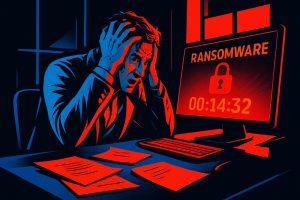
The alert appears on screen without warning: all files are encrypted and there is a deadline to pay. For many Portuguese SME managers, this is the most stressful moment they have ever experienced in front of a computer. The pressure is real, the business is at a standstill, and the temptation to pay to solve the problem quickly is enormous. But is paying the ransom really the best decision? Or is there a smarter strategy?
This article is not a neutral guide about ransomware. It is a direct comparison between two approaches, with a clear recommendation at the end, designed for SMEs operating with real business networks, servers, VPN, WiFi and business support infrastructure, as happens in so many companies in Porto and Greater Porto.
Paying the ransom vs. Resisting and recovering: the differences that matter
The decision to pay or not pay is not just financial. It has operational, legal and reputational implications that many managers only discover after making the wrong decision. See the direct comparison:
- Recovery speed: Paying may seem faster, but in practice it isn’t. Negotiating, transferring cryptocurrency and waiting for the decryption key takes hours or days, with no guarantee of results. With well-structured backups, recovery starts immediately and has a clear path.
- Guarantee of success: Paying guarantees nothing. Resisting with tested backups guarantees data recovery up to the last backup point.
- Future risk: Companies that pay become marked as targets that give in. The risk of a new attack increases. Companies that resist and fix the vulnerabilities come out stronger.
- Legal implications: In some cases, paying ransoms may violate European regulations, depending on who is behind the attack. GDPR compliance also requires the incident to be reported to the CNPD.
- Real cost: The ransom is never the only cost. Even when paying, there are costs related to downtime, forensic investigation, system rebuilding and client communication. These costs exist in any scenario, with or without payment.
Conclusion of this comparison: paying the ransom is the worst option in most real scenarios. The only possible exception would be the total absence of backups combined with absolutely critical data without any copy, but even then the decision should be made with specialised legal and technical advice.
Prevention is where the Portuguese SME wins or loses
The big difference between an SME that survives a ransomware attack and one that closes or pays is not in the response to the incident. It’s in what was done in the previous months. Prevention is not a luxury for large companies. It is the only economically rational strategy for an SME.
In a typical business network in Porto, with corporate WiFi, VPN for remote workers, file servers, CCTV system and Windows workstations, there are several attack vectors. Ransomware frequently enters via email (phishing), compromised credentials in remote access, outdated software, or personal devices connected to the business network without control.
The prevention measures that make a real difference for an SME include:
- Isolated and tested backups: The 3-2-1 rule is the minimum. Three copies, on two different media, one off-site or in the cloud. The critical detail: backups must not be accessible on the same network as production systems, otherwise ransomware will encrypt the backups too.
- Network segmentation: Separate office traffic, servers, CCTV and IoT devices. If ransomware enters through a workstation, it should not be able to reach the servers or the surveillance system.
- Next-generation endpoint protection: Solutions like Sophos Intercept X detect typical ransomware behaviours before encryption spreads across the network.
- Multi-factor authentication on all remote access: VPN without MFA is an open door. This is one of the most exploited entry vectors in Portuguese SMEs.
- Employee training: Most attacks start with a human click. Phishing simulations and regular training drastically reduce this risk.
If your company uses remote work infrastructure, the attack surface increases considerably and these measures become even more urgent.
What to do in the first hours after an attack
If ransomware has already entered, every minute counts, but haste cannot replace method. The correct sequence of actions makes the difference between a successful recovery and a bigger catastrophe:
- Immediately isolate the affected systems: Disconnect from the network (but do not turn off the power, to preserve evidence in memory). This prevents lateral spread across the business network.
- Do not restart the affected systems: Some ransomware destroys additional data on startup. Keep the current state for forensic analysis.
- Contact specialised technical support: Do not try to recover on your own. An experienced technician can identify the ransomware variant, check if a public decryptor is available, and assess the state of the backups.
- Report the incident: In Portugal, incidents involving personal data must be reported to the CNPD within 72 hours. CERT.PT must also be notified.
- Restore from validated backups: After ensuring the entry vector has been closed, start recovery from the most recent uncompromised backup.
For SMEs with external IT support, having a predefined incident response plan, with clear contacts and procedures, reduces reaction time from hours to minutes. The MEGABIT Hours Bundle allows SMEs to have this support available without the need to maintain a full-time internal IT department.
The direct recommendation: resisting is always the right strategy, but it requires preparation
MEGABIT’s position is clear: never recommend paying the ransom. Not for abstract ethical reasons, but for practical and measurable ones. Paying does not guarantee recovery, encourages new attacks, and does not fix the vulnerabilities that allowed entry.
The correct strategy for a Portuguese SME has two distinct moments. Before the attack: invest in prevention, isolated backups, network segmentation and employee training. After the attack: isolate, analyse, recover with technical support and report to the competent authorities.
SMEs that resist and recover without paying are those that treated cybersecurity as an operational priority, not as a cost to postpone. In the current Portuguese market context, where attacks on SMEs are increasing, this distinction can be the difference between continuing to operate or not.
Frequently Asked Questions
Is a Portuguese SME really an attractive target for ransomware attacks?
Yes, and increasingly so. Ransomware groups have realised that large companies have dedicated security teams and resources to resist. SMEs, on the other hand, have valuable data, less protected infrastructure and greater pressure to restore operations quickly. In Portugal, the number of incidents reported to CERT.PT involving SMEs has been growing steadily in recent years.
If I pay the ransom, am I guaranteed to recover my files?
There is no guarantee whatsoever. International studies show that a significant proportion of companies that paid the ransom either did not receive the decryption key, received a key that did not work properly, or were attacked again weeks later. Paying finances the attackers and signals that your company is willing to give in, making it an even more attractive target in the future.
How long does it take to recover from a ransomware attack without paying?
This depends directly on the quality of the backup strategy implemented before the attack. With regularly updated, isolated and tested backups, an SME can resume critical operations within a few hours. Without adequate backups, recovery can take days or weeks and may involve permanent data loss. That’s why investing in prevention is decisive.
—
MEGABIT works with SMEs in downtown Porto and throughout the Northern region of Portugal, helping implement cybersecurity strategies that work in practice: isolated backups, endpoint protection, network segmentation and incident response. If you want to assess your company’s exposure to ransomware risk or need support after an incident, contact us at comercial@megabit.pt.
Want to be notified when we publish our next article or video?
Free. Get notified as soon as we publish. No spam, easy to unsubscribe.