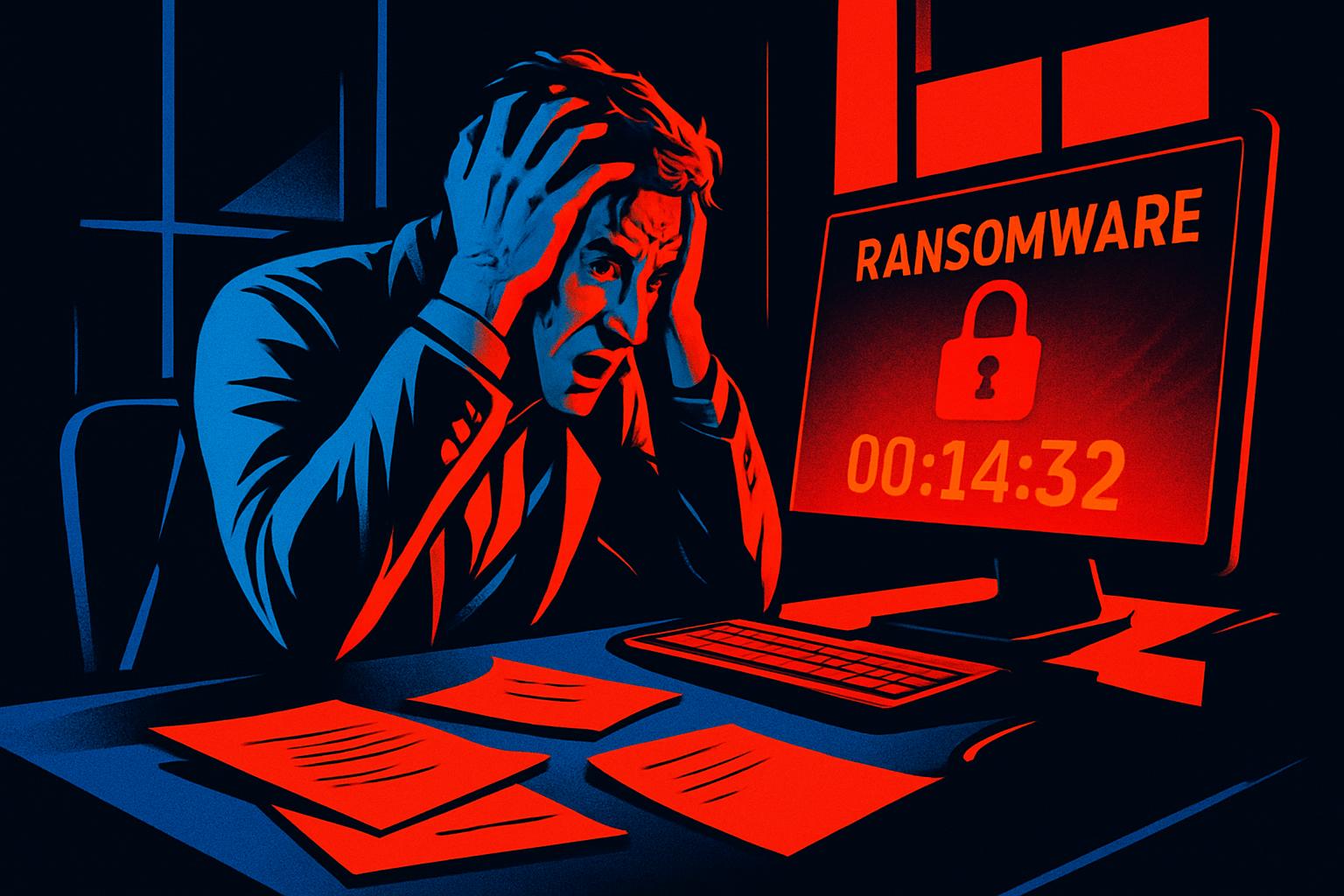
A locked screen, a message demanding payment in cryptocurrency, and a countdown timer ticking down. For hundreds of Portuguese SMEs, this is not a hypothetical scenario, it’s a reality that happens every week. Portugal has seen a significant increase in recent years in ransomware attacks targeting small and medium-sized businesses, precisely because they tend to have less protected infrastructure than large organisations, but data valuable enough to justify the attack.
The question that paralyses managers at this critical moment is always the same: pay the ransom and try to recover quickly, or resist and try to rebuild without giving in to extortion? The answer isn’t simple, but there is a clear position to defend, and this article presents it with concrete data so that your company is prepared before having to make that decision.
Paying the ransom: what seems easy and what really happens
The logic of paying seems appealing under pressure: pay, receive the decryption key, and resume activity. In practice, this path has consequences that are rarely communicated clearly.
- There’s no guarantee of full recovery: international studies indicate that a significant percentage of companies that pay don’t recover all their data, or receive decryption tools with errors that corrupt files.
- The company gets marked as a payer: by paying, the organisation signals to attackers that it’s willing to give in. Cases of the same company being reinfected months later are documented and recurrent.
- Funding criminal activity: payment directly funds the groups that develop and distribute ransomware, perpetuating the cycle of attacks.
- Growing legal exposure: some jurisdictions are regulating the payment of ransoms to groups classified as criminal organisations, which can create legal liability for the paying company.
- The root cause remains active: paying doesn’t eliminate the vulnerability that allowed the attack. Without fixing the original flaw, the company remains exposed.
Recovering without paying: what it requires and what it guarantees
The alternative to paying is autonomous technical recovery, and this is only viable with prior preparation. It’s not a decision made at the moment of attack, but a strategy built weeks and months in advance.
- Isolated and tested backups: the only way to recover data without paying is to have recent backup copies, stored outside the main network, that attackers can’t encrypt. A backup continuously connected to the network is just as vulnerable as the original data.
- Network segmentation: in a well-segmented infrastructure, ransomware spreads with greater difficulty between servers, workstations, WiFi devices and CCTV systems. Damage containment is more effective.
- Documented incident response plan: knowing exactly what to do in the first two hours of an attack, who to contact, which systems to isolate and how to activate backups, dramatically reduces downtime.
- Active managed security tools: solutions like Sophos Intercept X with behavioural detection can identify and block ransomware before full data encryption, limiting the impact of the attack.
Pay vs. Recover: direct comparison for SMEs
The following table summarises the essential differences between the two approaches so you can clearly assess the risk:
- Recovery speed: Paying may seem faster, but decryption is often incomplete. Recovering with solid backups can be just as fast or faster, with a guaranteed outcome.
- Guarantee of data access: Paying offers a weak guarantee, dependent on the good faith of criminals. Recovering with a backup offers a technical guarantee, auditable and controlled by the company itself.
- Risk of reinfection: Paying doesn’t eliminate the vulnerability and increases the risk of a new attack. Recovering with an infrastructure review eliminates the root cause.
- Reputational impact: Paying can become public and generate distrust among clients and partners. Recovering autonomously demonstrates resilience and technological maturity.
- Legal standing: Paying carries growing regulatory risks. Recovering autonomously involves no additional legal exposure.
The conclusion is clear: paying the ransom is the most expensive, least reliable and most dangerous option in the medium term. The only sustainable strategy for a Portuguese SME is to invest in prevention and prepare recovery before any incident.
What a Porto SME should do today to avoid reaching this dilemma
Effective protection against ransomware doesn’t require an in-house IT department of ten people. It requires consistency, the right tools and a technical partner who understands the reality of Portuguese SMEs.
The critical points to address in the infrastructure of any company in Porto or Greater Porto include VPN and remote access security, segmentation of the corporate WiFi network from guest networks, protection of physical and virtual servers, review of CCTV cameras and IoT devices with outdated firmware, and implementation of automatic backups with copies outside the main network.
For companies without dedicated in-house technicians, the MEGABIT Hour Bank model is the most efficient way to have specialised support available without the costs of an internal structure. The client uses the hours they need, when they need them, with no fixed monthly fee or mandatory loyalty commitment, making it the preferred model for SMEs that want agility and control over IT costs.
If your company still doesn’t have a documented cybersecurity incident response plan, now is the right time to act. An audit of the existing infrastructure, including network, servers, backups and connected devices, is the starting point for building a realistic security posture proportional to your organisation’s profile. Learn more about IT support for businesses in Porto and understand how to structure this process with the right support.
Frequently Asked Questions
Does cyber insurance cover ransomware attacks on SMEs?
Some cyber insurance policies partially cover recovery costs after a ransomware attack, including forensic consultant fees and operational costs during the disruption. However, most require the company to demonstrate it had active security measures before the attack, such as regular backups, managed antivirus and documented access policies. Without this evidence, the insurer may refuse compensation. Always check the specific conditions of your policy.
How long does it take an SME to recover from a ransomware attack without paying the ransom?
Recovery time depends directly on the quality of the existing backup infrastructure. A company with updated, tested backups isolated from the main network can recover within 24 to 72 hours. Without adequate backups, recovery can take weeks or simply be impossible for some data. This is why prior preparation is the only factor that truly determines response speed.
Can ransomware affect CCTV cameras and other network devices in my company?
Yes. CCTV cameras, routers, switches, NAS and any device connected to the corporate network can be compromised or serve as an entry point for a ransomware attack. IoT and video surveillance devices are often overlooked in security policies, but have outdated firmware and default credentials that make them easy targets. A security audit of the entire infrastructure, including WiFi, VPN and CCTV, is essential to identify these vulnerabilities.
Protect your company before the next attack happens
MEGABIT works with SMEs in downtown Porto and throughout northern Portugal to implement realistic cybersecurity strategies, test and validate backup plans, and ensure your infrastructure is prepared to resist, and recover, without relying on the good faith of criminals. If you want to understand exactly where your company is most exposed, contact us: comercial@megabit.pt.
Want to be notified when we publish our next article or video?
Free. Get notified as soon as we publish. No spam, easy to unsubscribe.